

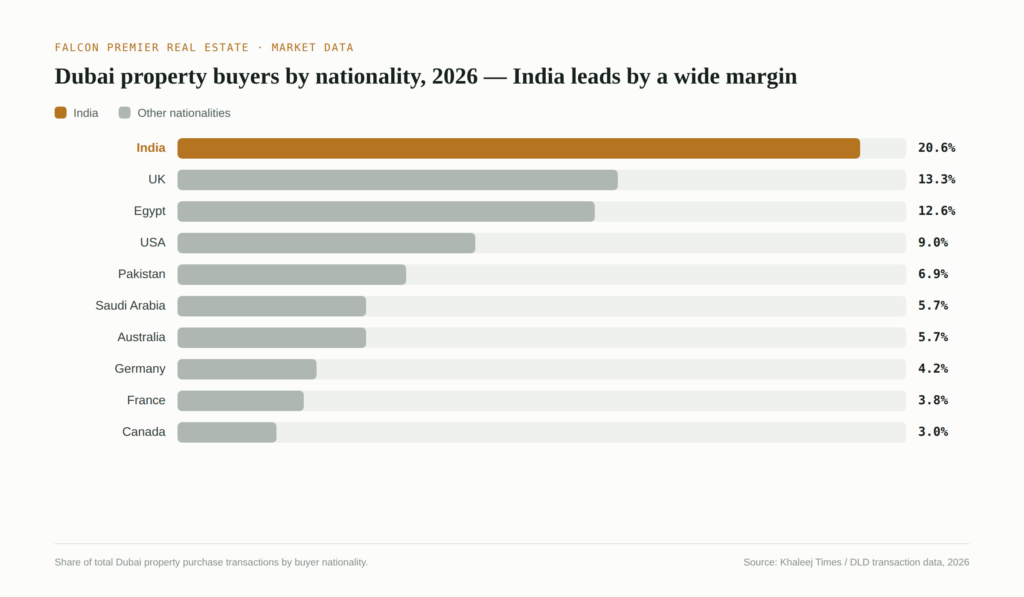
Indian investors haven’t just joined the Dubai real estate market — they’ve come to lead it. Indians accounted for 20.6% of all Dubai property purchases in 2026, ahead of the UK (13.3%) and Egypt (12.6%), and comfortably clear of every other nationality buying in the market. That’s not a niche trend; it’s the single biggest buyer group in one of the world’s most international property markets.
Here’s what’s actually driving it — and the tax and compliance details most coverage of this trend leaves out.
The numbers behind the headline
| Nationality | Share of Dubai property purchases, 2026 |
|---|---|
| India | 20.6% |
| UK | 13.3% |
| Egypt | 12.6% |
| USA | 9.0% |
| Pakistan | 6.9% |
| Saudi Arabia | 5.7% |
| Australia | 5.7% |
| Germany | 4.2% |
| France | 3.8% |
| Canada | 3.0% |
Why Indian buyers specifically
Yield: a genuine upgrade over most Indian metros. Dubai’s studio/1-bedroom segment yields around 6.92% gross, and even the citywide average (5.53%) beats what most Indian cities offer. Mumbai investors see the sharpest contrast — Mumbai’s average gross yield sits at just 3.74%, less than half Dubai’s studio/1-bed rate. Delhi (6.12%) is closer to parity, and Bangalore (5.01%) sits in between. This isn’t true everywhere in India, but for anyone holding Mumbai property specifically, Dubai’s yield gap is hard to ignore.
Price arbitrage at the premium end. Dubai’s average off-plan rate (AED 2,030/sq ft, roughly ₹52,800/sq ft) runs at a fraction of what genuinely premium South Mumbai addresses command — Malabar Hill and Worli trade at ₹90,000–160,000/sq ft, two to three times Dubai’s rate for comparable prestige positioning. Even Lower Parel, South Mumbai’s more accessible entry point, starts around ₹45,000/sq ft — in the same range as Dubai. For an investor priced out of Mumbai’s top addresses, Dubai buys meaningfully more property for the same rupee outlay.
Zero personal income and capital gains tax — for the right investor. The UAE charges no income tax on rental income and no capital gains tax on sale, for individual investors under AED 1 million in annual business turnover, held personally rather than through a company. Combined with the Khaleej Times-cited factors of political stability and 100% foreign ownership in designated freehold areas, this is consistently the headline reason cited for the market’s pull. But — and this matters more for Indian buyers than almost any other nationality on this list — it isn’t automatically 0% for everyone. More on that below.
The Golden Visa. An AED 2 million property investment (about ₹5.2 crore) qualifies for a 10-year renewable UAE residency visa, sponsorable to a spouse, children and parents — a meaningful pull for high-net-worth Indian families looking at long-term mobility and diversification, not just yield.
Proximity and an existing community. Most major Indian cities are 3–4 hours from Dubai by direct flight, and the UAE’s Indian expatriate community is already the largest single nationality group in the country — meaning most buyers already have family, colleagues or a professional network on the ground before they even book a viewing.
Currency diversification. With the rupee trading in the mid-20s against the dirham and having weakened against the US dollar (to which the AED is pegged) over recent years, a Dubai property functions as a hard-currency-denominated asset — a genuine diversification point for investors whose wealth is otherwise entirely rupee-denominated.
The part most coverage skips: India still taxes this
Here’s the honest complication. The UAE’s 0% tax applies to what the UAE collects — it says nothing about what India collects, and for resident Indian taxpayers, that’s the number that actually matters.
If you’re a tax resident of India (broadly, someone living in India for most of the year), India taxes your global income — including rental income and capital gains from a Dubai property. Because the UAE charges no tax, there’s no foreign tax paid to claim as a credit under the India-UAE Double Taxation Avoidance Agreement (DTAA), so resident Indian investors pay full Indian tax rates on Dubai rental income and capital gains, with no offset. The 0% UAE rate doesn’t disappear — it just means India is the only one taxing you, not that nobody is.
If you qualify as an NRI (Non-Resident Indian, under India’s tax residency rules) the position is very different: foreign income generally isn’t taxed by India at all, meaning an NRI investor genuinely does capture the UAE’s 0% rate — which is a large part of why the UAE’s huge existing NRI population is such a natural, motivated buyer pool.
This distinction — resident vs. NRI — matters more to your actual after-tax return than almost anything else in this article, and it’s worth getting confirmed by a chartered accountant before you factor “zero tax” into your decision.
The compliance side: LRS, TCS and disclosure
For resident Indians remitting money to buy Dubai property, three rules matter:
- LRS limit: The Liberalised Remittance Scheme caps outward remittance at USD 250,000 per person, per financial year — not per family. Spouses can each remit their own USD 250,000, and adult children with their own PAN and income can add their own limit too, but there’s no carry-forward of unused allowance into future years.
- TCS on remittances: Tax Collected at Source applies at 20% on LRS remittances above ₹7 lakh in a financial year (for purposes other than education or medical expenses). This isn’t an extra cost — it’s credited against your final tax liability — but it is a real cash-flow hit at the time of transfer.
- Schedule FA disclosure: Resident Indians must declare foreign property holdings — address, ownership share, and any associated foreign bank account — on Schedule FA of their income tax return. Non-disclosure carries serious penalties under India’s Black Money Act. NRIs are exempt from this specific requirement on foreign assets.
There’s a reason regulators have taken a closer look at the pace of retail Indian money moving into Dubai property in recent years — informal or undocumented remittance channels create real legal exposure. Moving money through proper banking (AD-bank) channels and staying inside LRS limits isn’t just good practice; it’s what keeps a genuinely good investment from becoming a compliance problem.
What this means if you’re deciding
Dubai’s pull for Indian investors is real and backed by genuine numbers — yield, price, mobility and market depth all point the same direction. But the “zero tax” pitch you’ll see in most marketing is only the full story for NRIs; resident Indian investors are getting a strong property investment with real Indian tax obligations attached, not a tax-free one. Both can still be the right call — they’re just different calculations.
This is general market information, not tax, legal or investment advice. Indian tax residency rules, LRS limits and DTAA provisions are complex and change periodically — confirm your specific position with a chartered accountant and, for the remittance side, your bank’s authorized dealer, before committing funds.
Talk to someone who’s done this before
Falcon Premier’s team works with Indian investors across both NRI and resident scenarios and can walk through the property side of a purchase, including structuring it around the Golden Visa threshold if that’s part of the plan.