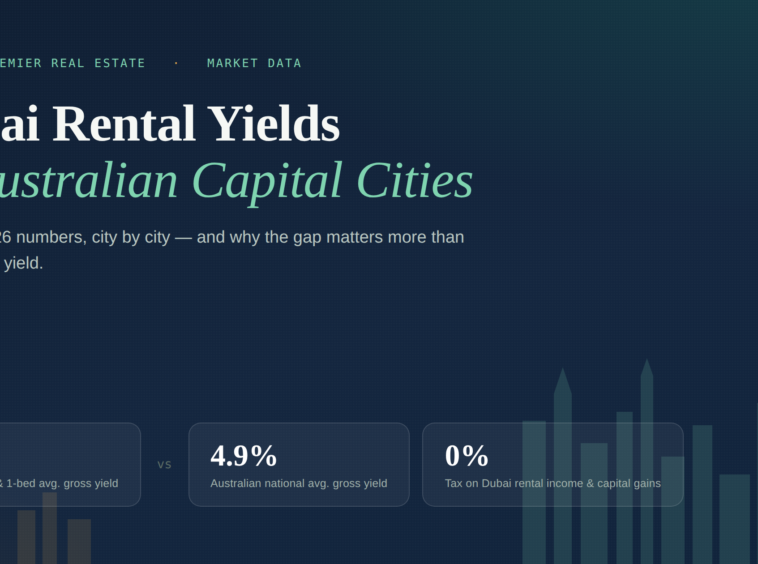
If you’ve spent any time comparing Dubai rental yields vs Australian capital cities, you’ve probably seen the same headline stat everywhere: Dubai yields around 7%, Australia yields around 4%, case closed. It’s a good hook. It’s also not the full picture — and the full picture is actually more useful to you as an investor.
Below are the real, sourced 2026 gross yield figures for Dubai and every Australian capital city, plus the part most comparisons leave out: what happens to that yield after tax, and why a change coming to Australian property investing in 2027 makes the Dubai side of this comparison more relevant than it was a year ago.
Dubai vs Australia: gross rental yields, city by city (2026)
| Location | Gross rental yield | Segment |
|---|---|---|
| Dubai | 6.92% | Studio / 1-bedroom average |
| Darwin | 6.46% | All dwellings |
| Melbourne | 5.78% | All dwellings |
| Canberra | 5.54% | All dwellings |
| Dubai | 5.53% | City average, all property types |
| Perth | 4.87% | All dwellings |
| Sydney | 4.72% | All dwellings |
| Gold Coast | 4.35% | All dwellings |
| Adelaide | 4.07% | All dwellings |
| Brisbane | 3.73% | All dwellings |
Gross yields, before tax and running costs. Net yields typically run 1.5–2 percentage points lower in both markets. Sources: Global Property Guide (Q2–Q3 2026 data); see methodology note below.
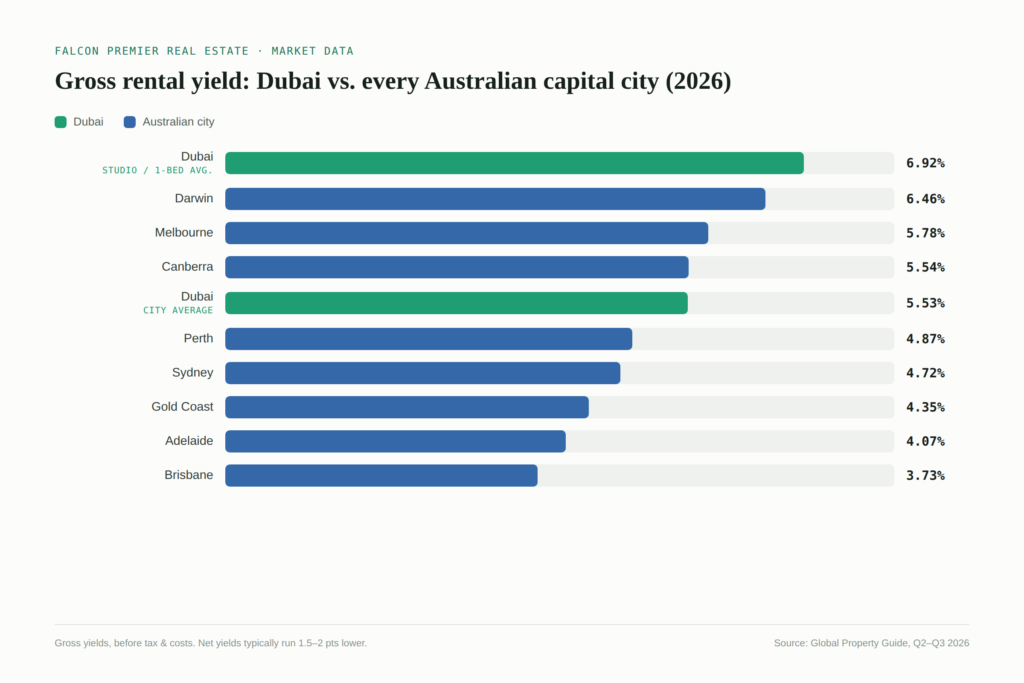
Two things stand out once you see it laid out this way.
First, Dubai’s city-wide average (5.53%) doesn’t actually beat every Australian capital — Darwin and Melbourne both edge it on raw yield, and Canberra sits right alongside it. Any comparison that tells you Dubai automatically wins on yield everywhere in Australia isn’t being straight with you.
Second, the property type most overseas investors actually buy in Dubai — studios and one-bedroom apartments, the bread-and-butter of off-plan investment in areas like JVC and Arjan — yields 6.92% on average, which does outperform every Australian capital city except Darwin. That’s the number that matters if you’re comparing like-for-like against the kind of property you’re likely to buy.
Why the yield gap isn’t even the main story
Here’s the part that gets left out of most “Dubai vs Australia” content: yield is a pre-tax number, and the two countries tax property investors very differently.
In the UAE, there is no personal income tax on rental income and no capital gains tax when you sell. A 6.92% gross yield in Dubai is close to a 6.92% effective return, minus running costs.
In Australia, rental income is taxed at your marginal rate (up to 45% at the top bracket), and capital gains are taxed too — currently with a 50% CGT discount for assets held over 12 months. So a Melbourne property yielding 5.78% gross can, after tax, land well below a Dubai property yielding a similar or lower headline number.
There’s also a change worth knowing about if you’re weighing this up in 2026. In the May 2026 federal budget, the Australian government announced that negative gearing will be restricted to new residential properties from 1 July 2027 — investors buying an established property after that date won’t be able to negative-gear it against their other income, though losses can still be carried forward. Capital gains tax is changing too: the flat 50% discount is being replaced with cost-base indexation plus a 30% minimum tax rate on gains. Anyone who already owns Australian property, or buys before the cut-off, is largely grandfathered in — but it’s a real shift in how favourable established Australian property will be for new investors from mid-2027 onward, and it’s pushing more Australian investors to look at what a zero-tax jurisdiction like Dubai actually offers by comparison.
This is general information, not tax or financial advice — the negative gearing and CGT changes affect people differently depending on when they bought and what they hold. Speak with a licensed Australian tax adviser about your own position before acting on any of this.
What the numbers look like on an actual purchase
Take a AED 1.2 million (roughly AUD 490,000) one-bedroom apartment in a growth area like JVC or Arjan, generating a 6.9% gross yield:
- Gross annual rent: ~AED 82,800 (~AUD 34,000)
- Tax on that rental income in Dubai: AED 0
- Tax on the equivalent rental income if it were an Australian property, at a 32.5% marginal rate: roughly AUD 11,000 a year gone before you’ve paid a single running cost
That gap compounds every year you hold the property, and again at sale, since Dubai charges no capital gains tax at all.
Where each Australian city actually stands
- Sydney (4.72%): the highest-priced market with one of the lower yields on this list — the trade-off Sydney investors already know well.
- Melbourne (5.78%): genuinely yield-competitive with Dubai’s city average, but still taxed on income and gains the way every Australian property is.
- Brisbane (3.73%): the lowest yield of the eight capitals, despite strong price growth in recent years.
- Perth (4.87%) and Adelaide (4.07%): mid-pack, broadly in line with the national average of 4.94%.
- Canberra (5.54%) and Darwin (6.46%): the two cities that hold their own against Dubai on raw yield — worth knowing if you’re benchmarking against your own portfolio rather than the “Australia” average.
FAQ
Is the rental yield in Dubai higher than in Australia? On a national-average basis, yes — Dubai’s city-wide average of 5.53% and studio/1-bedroom average of 6.92% both sit above Australia’s national average of 4.94%. But Darwin (6.46%) and Melbourne (5.78%) both out-yield Dubai’s city average on paper, so “Dubai always wins on yield” isn’t accurate — Dubai’s advantage is stronger in the studio/1-bed segment and much stronger after tax.
Are these net or gross yields? Gross — before tax, service charges, management fees and vacancy. Net yields typically run 1.5–2 percentage points lower in both Dubai and Australia, so use gross figures to compare markets and net figures to budget your actual return.
Do Australians pay tax on rental income from a Dubai property? Dubai and the wider UAE don’t tax rental income or capital gains. Australian tax residents may still have obligations to declare foreign income to the ATO — this varies by individual circumstances, so check with a tax adviser experienced in foreign property income.
How will the 2027 negative gearing changes affect me? If you already own an Australian investment property, or buy one before 1 July 2027, you’re largely unaffected by the new rules. They apply to established properties bought after that date, which will no longer be eligible for negative gearing against other income. It’s one more reason overseas diversification is getting more attention from Australian investors in 2026.
Thinking beyond the yield number
Yield is one input, not the whole decision — currency risk, off-plan payment timing, and how a property gets managed from 14,000km away all matter too. If you want to see how the after-tax numbers actually compare for a specific budget, Falcon Premier’s team can walk you through it against your own numbers.
Methodology & sources
- Dubai and Australian gross rental yield figures: Global Property Guide, UAE data dated May 2026 (Q2 2026), Australia data dated August 2026 (Q3 2026).
- Australian negative gearing and capital gains tax reform: Australian Government, 2026–27 Federal Budget tax fact sheet, announced 12 May 2026, effective 1 July 2027.
- All figures are gross, directional, and subject to change as new quarterly data is published — reconfirm before publishing anything time-sensitive from this table.