
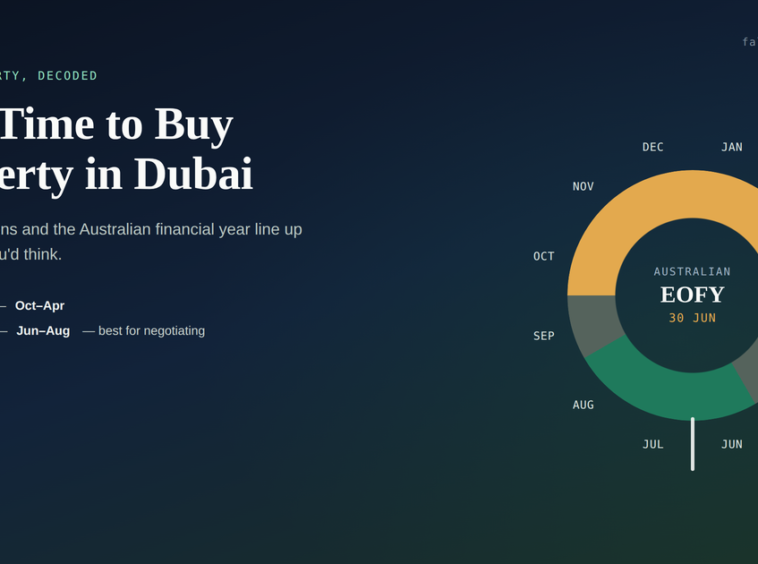
Search “best time to buy property in Dubai” and you’ll get a dozen confident answers, each naming a different month. That’s usually a sign the question is being asked wrong. Dubai doesn’t have a single best month — it has a seasonal rhythm, and separately, you have a financial year that ends on 30 June whether Dubai’s market cares or not. The useful question isn’t “when is the best time” — it’s how those two calendars actually line up, and what to do about it.
They line up better than you’d expect. Here’s the real pattern, and where EOFY fits into it.
Dubai’s actual seasonal pattern
October to April is peak season. Cooler weather brings tourists, returning expats, and property viewings back in force. More buyers are actively looking, which means more competition and less room to negotiate — sellers and developers have the upper hand.
June to August is the quiet season. The heat sends residents travelling and slows foot traffic across the market. Fewer active buyers means sellers who listed during the busy season have more incentive to negotiate by the time summer rolls around, and developers are more likely to sweeten a payment plan to keep sales moving.
Ramadan isn’t the slowdown it used to be. The old assumption was that not much happens during Ramadan. The 2026 data says otherwise — Dubai real estate transactions actually rose during Ramadan 2026, with reports of activity up 8–12% and transaction value climbing nearly 30% year-on-year. Worth knowing so you don’t rule out a window that’s still very much active.
August/September and June/July see a rental and moving bump. Expat families tend to move around the school calendar, so listing and leasing activity ticks up at the start and end of the academic year.
None of this is a hard rule — Dubai’s own reporting is consistent that broader market fundamentals and government initiatives move prices far more than the season does. But if you’re choosing between two otherwise-equal moments to make an offer, quiet season beats peak season for negotiating room, most years.
Where the Australian financial year fits in
Here’s the coincidence that makes this genuinely useful rather than just trivia: the Australian financial year ends 30 June — right in the middle of Dubai’s quietest, most negotiable stretch.
That’s not nothing. EOFY is already the time of year Australians are reviewing their super contributions, prepaying deductible expenses, and taking stock of their overall financial position before the year closes. If an overseas property purchase is part of that annual review anyway, doing the serious shopping and negotiating in May or June means you’re active in Dubai’s market at exactly the point sellers are most willing to move on price.
What EOFY actually changes (and what it doesn’t)
To be clear about what’s real here: the UAE doesn’t have a financial year deadline that affects your purchase. There’s no Dubai equivalent of 30 June — no rush to settle before a cut-off, no tax reason the purchase itself has to land in any particular month. Property tax residency and reporting obligations run on the UAE’s own rules, not Australia’s.
What the Australian financial year does affect is everything on your side of the transaction: if you’re planning to fund a Dubai purchase by realising gains (or harvesting losses) on Australian shares or property, the timing of that sale relative to 30 June affects which financial year the gain lands in. Once you own the Dubai property, any rental income becomes assessable on your Australian tax return in the year it’s earned, regardless of when in the calendar you bought — so buying in May versus August mostly changes how many months of rental income (and expenses) show up on this year’s return versus next year’s.
None of this is tax advice, and the details depend on your residency status, other income, and how the property’s held — talk to an accountant who handles foreign investment income before you plan a purchase around EOFY specifically. The point isn’t to engineer a transaction around a deadline. It’s that your annual EOFY review is a natural, already-scheduled moment to make the decision — and it happens to fall when Dubai’s market is most willing to make a deal.
A simple annual rhythm
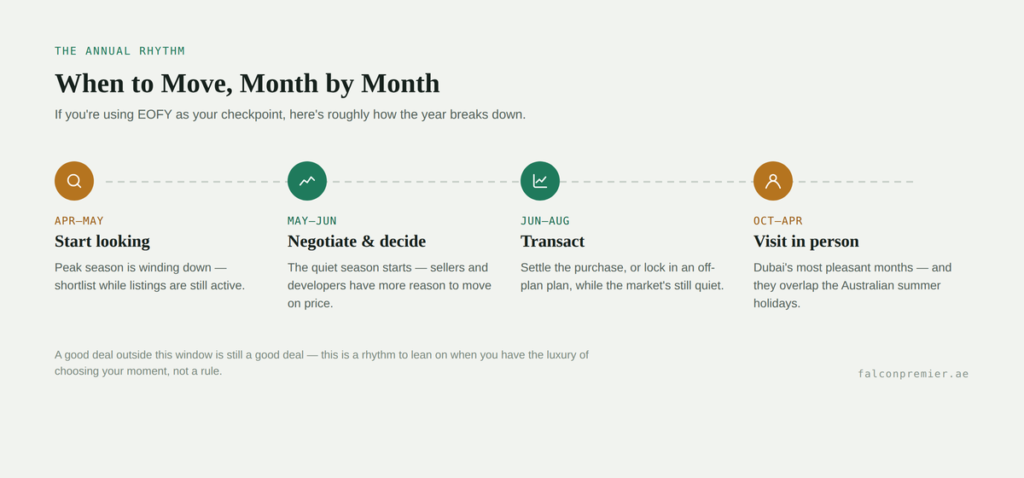
If you’re using EOFY as your checkpoint, here’s roughly how the year breaks down:
April–May — start looking. Peak season is winding down, listings are still active, and you have time to shortlist before the quiet season negotiating window opens.
May–June — negotiate and decide. This is the sweet spot: sellers and developers are more flexible, and it lines up with your EOFY financial review anyway.
June–August — transact. Settle the purchase (or lock in an off-plan payment plan) while the market’s still quiet, ideally with the groundwork from your EOFY planning already done.
October–April — visit in person, if you haven’t already. If seeing the property or the building matters to you before you’re fully committed, this is when Dubai is most pleasant to be in — and it happens to overlap with the Australian summer holidays if you’re planning the trip around Christmas or New Year.
You don’t need to force every purchase into this exact rhythm — a good deal in November is still a good deal. But if you’re not in a hurry and can choose your moment, this is the version of “best time to buy” that’s actually grounded in something real.
FAQ
Is Ramadan a bad time to buy property in Dubai? Not based on recent data. Dubai real estate transactions rose during Ramadan 2026, so it’s no longer a reliable “quiet” window — treat it like any other month rather than avoiding it.
Does the Australian financial year affect tax on Dubai property? Not directly — the UAE has no financial-year deadline of its own. What it affects is when rental income and expenses from the property land on your Australian tax return, and potentially the timing of any Australian asset sales you use to fund the purchase. Speak to an accountant familiar with foreign investment income for specifics.
What month has the best property deals in Dubai? Historically, June to August — the quiet season, when fewer active buyers gives sellers and developers more reason to negotiate. October to April tends to favour sellers, with more buyers competing for the same listings.
Should I time an off-plan purchase around the quiet season too? It can help — developers are also more likely to offer incentives (payment plan sweeteners, fee waivers) when overall buyer traffic slows. If you’re still deciding between off-plan and ready property, that’s a separate decision worth reading up on first.
Where to go from here
There’s no single magic month to buy property in Dubai — but there is a version of “best time” that holds up: the quiet season gives you room to negotiate, and it happens to fall right when Australians are already reviewing their finances for EOFY. If you’re weighing that decision this year, our guide on off-plan vs ready property in Dubai is the natural next read, or start with the full guide to how Australians can buy property in Dubai if you’re earlier in the process.