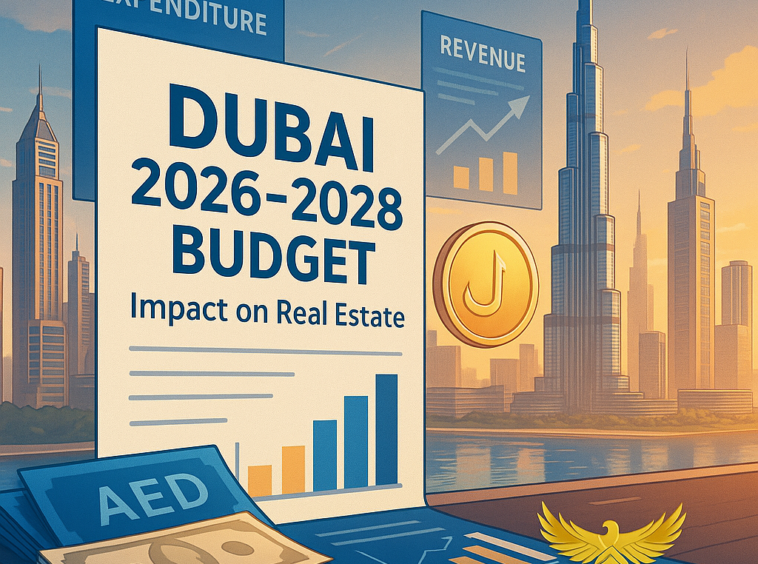
Dubai has just approved its largest-ever government budget — total expenditure of Dh 302.7 billion for 2026–2028 — a development with far-reaching implications for the emirate’s infrastructure, growth trajectory, and crucially, the real estate sector.
For anyone considering buying property in Dubai, this bold financial plan marks a pivotal moment. At Falcon Premier Real Estate, we believe this budget will act as a catalyst — boosting demand, stimulating construction, enhancing living standards, and offering prime conditions for both investors and homeowners.
In this post, we dissect what the budget entails, how it translates to real estate dynamics, and why 2025–2028 may present one of the best windows for property investment in Dubai.
🔎 1. What’s in the New Dubai Budget (2026–2028)
- Record-high cycle: The 2026–2028 cycle sets expenditure at Dh 302.7 billion, with projected revenues of Dh 329.2 billion.
- 2026 snapshot: For the year 2026 alone — expenditure is Dh 99.5 billion, and revenues are forecast at Dh 107.7 billion.
- Fiscal surplus & stability: Dubai expects an operating surplus of up to 5% of GDP in 2026, underlining fiscal discipline and sustainable planning.
- Spending priorities:
- 48% on infrastructure and construction (roads, transport, utilities, public amenities)
- 28% earmarked for social development — health, education, housing, community services.
- 18% for security, justice, public safety.
- 6% reserved for government development and administrative upgrades.
This budget reflects a comprehensive push across infrastructure, social welfare, public services, and long-term economic growth — signaling strong confidence from Dubai’s leadership in the emirate’s future.
🏡 2. Why This Budget Matters for the Real Estate Market
🚧 Infrastructure & Mobility Boost
With nearly half the budget allocated to infrastructure and construction, expect major upgrades in roads, public transport, utilities, and community amenities. This will enhance connectivity and livability — inevitably increasing demand for residential and commercial properties across Dubai.
📈 Demand Surge for Housing & Rentals
As social development, housing, and community services expand, population growth and migration are likely — which creates sustained demand for rental and owned housing. New families, professionals, and migrants will seek homes, pushing occupancy rates and property values.
🏗️ Acceleration of New Developments
Developers will likely accelerate new residential and mixed-use projects — from affordable housing to luxury towers — capitalizing on improved infrastructure and increased demand. This means more choices for buyers and investors, but also competition — so timing and project selection will be key.
🌐 Boost for Commercial & Mixed-Use Properties
Improved infrastructure, transport, and social services will also benefit commercial real estate — offices, retail, hospitality. Businesses may expand or relocate to Dubai, increasing demand for commercial space — a major plus for investors leaning toward mixed-use investments.
💡 Long-Term Market Confidence & Stability
The scale and transparency of the budget — with surplus projections and diversified allocations — boosts confidence among local and foreign investors. This stability tends to attract long-term property investment, reducing speculative volatility.
🔮 3. What This Means for 2025–2028 Real Estate Investors
| Strategy | Why It Works Now |
|---|---|
| Buy mid-term apartments/townhouses | Infrastructure upgrades + rental demand → steady rental yields & appreciation |
| Invest in off-plan/new developments | Early entry before demand spikes; variety of options across budget ranges |
| Commercial & mixed-use units | Growth in business, transport, services → rising demand for offices & retail spaces |
| Buy-to-rent for expats/foreigners | Improved amenities + expat influx → stable tenancy & yields |
| Long-term holdings & capital appreciation | Economic confidence & population growth drive long-term value growth |
🏁 4. What to Watch Out For (Risks & Smart Buyer Tips)
- Supply growth rate — new project launches could lead to short-term oversupply; choose developer and timing carefully.
- Location matters: Focus on areas benefiting from upcoming infrastructure projects.
- Quality and delivery risk: Opt for trusted developers with proven track records — avoid projects with uncertain handover schedules.
- Market segmentation: Not all segments — luxury, budget, mid-market — will perform equally; align choice with demand trends.
At Falcon Premier Real Estate, we help you match your investment goal with the right property type and location based on these dynamics.
💬 5. What Experts & Leaders Say
Sheikh Mohammed bin Rashid Al Maktoum and Sheikh Hamdan bin Mohammed bin Rashid Al Maktoum have emphasized that this budget is part of a long-term roadmap — aimed at doubling Dubai’s GDP and securing its place among the world’s top three urban economies.
Analysts believe the balanced mix of infrastructure, social development, and fiscal surplus makes this budget cycle a rare window of opportunity for investors seeking stable, long-term growth.
🎯 Conclusion
The newly approved Dubai 2026–2028 budget isn’t just a number — it’s a blueprint for the emirate’s future. For property buyers, investors, and renters, it signals strong potential: rising demand, improved infrastructure, expanding services, and long-term stability.
At Falcon Premier Real Estate, we believe this is an ideal time to review your investment strategy, explore mid- to long-term property options, and secure assets that align with Dubai’s growth trajectory.
📞 Contact Falcon Premier Real Estate or WhatsApp us at +971 54 279 1796 to explore exclusive opportunities — and ride the wave of Dubai’s next growth phase.