Imagine stepping out of your penthouse in July, when the thermometer reads 45°C, and cycling ten kilometres to brunch in shorts — never once feeling the heat. That is the promise behind The Loop, one of the most ambitious urban concepts Dubai has produced, and it points to a question every serious buyer should be asking: what happens to luxury property values when a city designs itself around health, climate and walkability?
At Falcon Premier, we track the ideas shaping tomorrow’s most desirable addresses. The Loop is exactly that kind of idea.
What is The Loop?
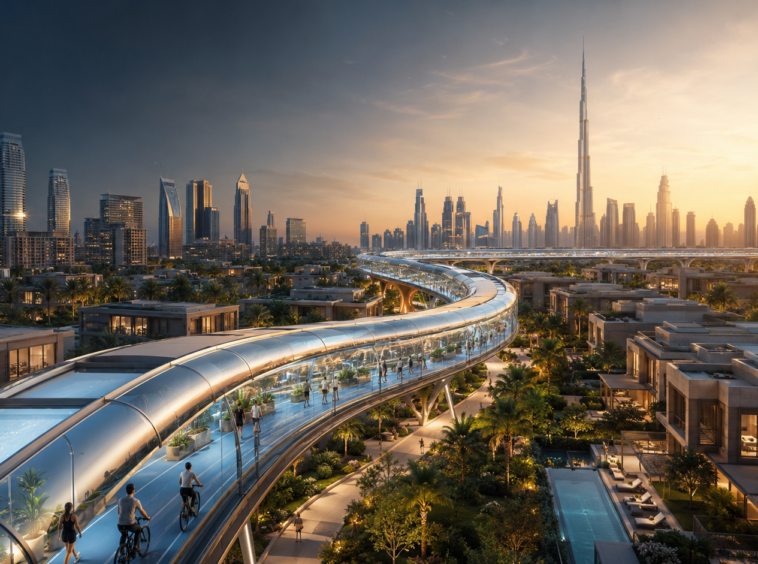
The Loop is a proposed 93-kilometre climate-controlled pathway, designed by Dubai-based sustainable development firm URB, that would thread through the city as one continuous enclosed structure. Rather than a single building, it behaves like an entirely new layer of urban infrastructure — a linear indoor city connecting major districts end to end.
Inside, the route is far more than a walkway. The design sets out dedicated lanes for cycling, running and pedestrians, running alongside tropical landscaping, cafés, social spaces, urban farms and water features — all sealed against Dubai’s extreme summer heat. The concept also explores advanced air filtration, recycled construction materials, kinetic flooring that generates electricity as people move across it, water-recycling systems and underground transport links.
URB frames the ambition simply: connect more than three million residents to key services and destinations by foot or bike within minutes, all year round. For now, The Loop remains a vision in its research and development phase rather than a completed project. But visions like this have a way of moving markets long before the ribbon is cut.
Why walkability is the new luxury
For decades, luxury in Dubai was measured in square footage, skyline views and marble finishes. That has not disappeared — but the definition is widening. The buyers we work with increasingly ask a different set of questions: How do I live here in August? Can my family walk to a café, a park, a gym without getting into a car? Is this a place that supports the way I want to live, not just the way I want to be seen?
This is where The Loop matters, even as a concept. It signals a citywide shift toward wellness-led, climate-resilient urban design — and that shift is already reflected in where premium capital flows. Around the world, walkable neighbourhoods command measurable price premiums over car-dependent ones. In a city where the outdoors is genuinely unusable for several months a year, the ability to walk, exercise and socialise comfortably in any season is not a lifestyle nicety. It is a structural advantage that few markets can offer, and one that discerning buyers are willing to pay for.
The Loop takes Dubai’s existing strengths — its shaded promenades, its air-conditioned retail districts, its master-planned communities — and imagines them stitched into a single continuous network. For a high-net-worth buyer, that is a preview of where the city’s most valuable postcodes are heading.
What this means for luxury buyers and investors
A concept in R&D will not directly move a valuation next quarter. But the thinking behind The Loop offers a clear lens for making sharper property decisions today.
Proximity to future connectivity will be repriced. Whenever Dubai commits to major infrastructure — a new metro line, a marina, a landmark district — the properties within walking distance appreciate first and hold value best. If any segment of a climate-controlled network like The Loop is ever built, the residences that plug into it will enjoy exactly this kind of premium. Buying in districts already flagged for pedestrian and transit investment is a way to position ahead of that curve.
Wellness infrastructure is becoming a value driver, not an amenity. Communities that already deliver shaded walkways, cycling tracks, parks and indoor-outdoor living are effectively offering a small-scale version of what The Loop promises citywide. These are the addresses that tend to outperform when buyer priorities shift toward health and liveability — which they demonstrably are.
Year-round usability protects rental yields. Properties in genuinely walkable, amenity-rich communities let tenants and owners live fully in every season, which sustains demand and occupancy through Dubai’s hottest months. For an investor, that resilience is what separates a trophy asset from a truly performing one.
Sustainability credentials increasingly influence prestige. The Loop’s emphasis on recycled materials, energy generation and water recycling reflects where global luxury is heading. Green-certified, energy-efficient homes are moving from niche to expected among the world’s wealthiest buyers, and Dubai’s premium developments are following suit.
Where the smart money is already looking
You do not have to wait for The Loop to invest in the future it represents. Dubai’s most forward-looking communities are building climate-conscious, walkable environments right now.
Waterfront and master-planned districts — think the established promenades of Dubai Marina, the beachfront living of Emaar Beachfront, the wellness-oriented design of Dubai Hills Estate, and the emerging luxury of Palm Jebel Ali — are already competing on liveability, shade, connectivity and green space, not just on views. Off-plan launches in these areas increasingly bake in exactly the principles The Loop celebrates: pedestrian-first layouts, integrated retail and leisure, and generous landscaping designed for the climate.
For buyers pursuing residency alongside lifestyle, these same communities frequently sit comfortably above the property thresholds that qualify for the UAE Golden Visa, pairing long-term security with the kind of walkable, wellness-led living that the next decade of Dubai will be built around.
The bottom line
The Loop may or may not be built as drawn. But it captures a direction of travel that is unmistakable: Dubai is reimagining itself around health, climate resilience and walkability, and the properties aligned with that vision are the ones best positioned to hold and grow their value. For high-net-worth buyers, the opportunity is not to speculate on a single concept — it is to recognise the shift it represents and to buy into the communities already delivering on it.
Would you use a 93km indoor path like this? More importantly — is your Dubai property positioned for the city that will build one?
At Falcon Premier, we help discerning buyers identify the communities, off-plan launches and landmark residences most aligned with where Dubai is heading. If you would like a private consultation on future-ready luxury addresses, get in touch with our team.
Frequently asked questions
Is The Loop Dubai actually being built? Not yet. The Loop is a concept by sustainable development firm URB, currently in its research and development phase. It is a serious, fully designed proposal rather than an approved construction project — but it reflects a genuine direction in Dubai’s urban planning around climate resilience and walkability.
How long is The Loop? The proposed route is approximately 93 kilometres, forming one continuous climate-controlled pathway connecting major districts across the city for cyclists, runners and pedestrians.
How does a project like this affect Dubai property values? Major connectivity and lifestyle infrastructure has historically lifted the value of nearby luxury property in Dubai. While The Loop itself is not yet built, the wellness-led, walkable design principles behind it are already shaping the communities that command premium prices and stronger rental demand.
Which Dubai communities best reflect this walkable, climate-conscious future today? Waterfront and master-planned districts such as Dubai Marina, Emaar Beachfront, Dubai Hills Estate and Palm Jebel Ali are already built around shade, green space, connectivity and year-round liveability — the same principles The Loop imagines at citywide scale.