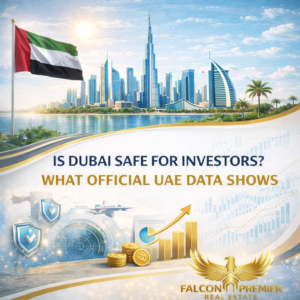
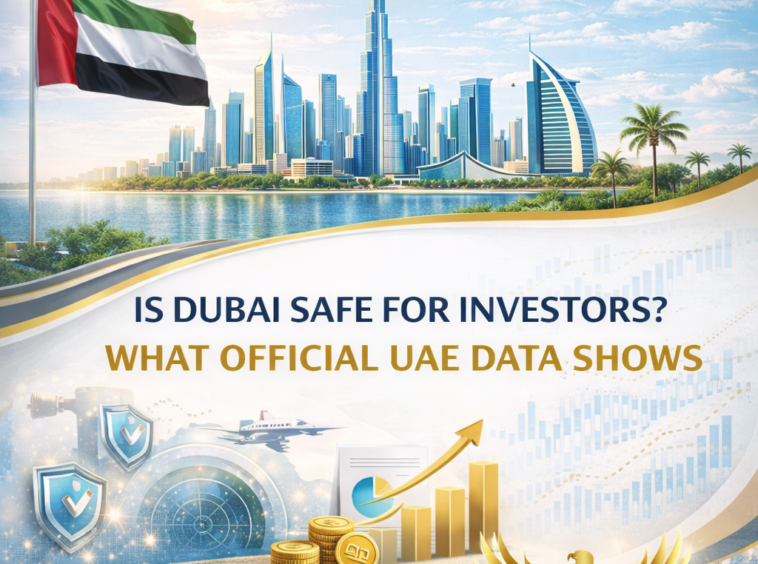
When regional tensions rise, fear usually spreads faster than facts. For many people considering Dubai, the first question is no longer only about returns or long-term value. It is much simpler: is Dubai safe for investors right now? The best way to answer that is not through rumours or social media clips, but through official UAE updates and recent market data.
What official UAE updates say right now
In its recent media briefing, the UAE government said it remains at the highest levels of operational readiness and reaffirmed its commitment to protecting national sovereignty, safeguarding economic stability, and maintaining the uninterrupted delivery of essential services. In the same briefing, the Ministry of Interior said the security situation remains stable across all Emirates, and that security and police services continue without interruption.
The Ministry of Defence also outlined the scale of the response. In official WAM updates through 8 March, the UAE reported 238 ballistic missiles detected, with 221 destroyed and 15 falling into the sea. It also reported 1,422 drones detected, with 1,342 intercepted, and said eight cruise missiles had been detected and destroyed. In the government briefing, officials added that the majority of recorded impacts were linked to interception operations rather than direct strikes.
Why continuity matters more than headlines
For investors, continuity matters as much as headlines. The UAE government said the national economy continues to show resilience, supported by diversification, openness, and proactive policy frameworks. It also said the country has strategic reserves of essential goods covering four to six months of market needs, while authorities continue daily stock monitoring and real-time price oversight across hundreds of major outlets.
That operational continuity extends well beyond supermarkets or supply chains. The same official briefing said the UAE tourism sector continues to operate normally, with 1,260 hotels and more than 40,000 tourism-related companies active, while hotels, resorts, attractions, and shopping centres remain open and compliant with safety standards. The government also said emergency air corridors were activated, with current operational capacity at 48 flights per hour, and that thousands of affected passengers had already been transported on national-carrier flights.
Dubai’s reputation is built on systems, not sentiment
Dubai’s strength has never been based only on image. It has been built on infrastructure, governance, and the ability to keep daily life functioning under pressure. Dubai’s official tourism portal describes the city as one of the world’s safest cities, which aligns with the broader picture the UAE government is trying to reinforce through its security, transport, and business-continuity measures.
That matters for investors because capital usually follows places where systems work. A strong market is not defined only by whether prices move up or down in a given month. It is also defined by whether a city can maintain public order, essential services, mobility, and confidence when external pressures increase. On that point, the current official picture is clear: the UAE is presenting itself as organised, responsive, and operational.
What recent Dubai market data says about confidence
Recent Dubai Land Department data adds another important layer to the story. DLD said that in 2025, registered tenancy contracts rose 6% in volume and 17% in value year over year, reaching 1.38 million contracts worth AED126.4 billion. DLD said this reflects the stability of the real estate market, increased demand, and greater operational maturity.
DLD also reported that Dubai’s real estate market recorded 217,000 investments valued at AED526 billion in 2024, while attracting 110,000 new investors. In the same announcement, officials said Dubai’s market remains among the world’s best, with a strong focus on transparency, investor confidence, stability, and sustainability.
What this means for investors considering Dubai
No serious investor should pretend that regional tensions do not matter. They do. But the official evidence does not point to a city that has stopped functioning. It points to a government in active response mode, continuity in essential services, a transport system under contingency management, and a property market that entered this period from a position of strong demand and broad investor participation. That does not eliminate risk, but it does change the quality of the conversation.
For long-term buyers, the smarter approach is to separate temporary fear from structural strength. The questions worth asking are practical ones: Are official institutions functioning? Is security stable? Are services and travel networks still operating? Is there still evidence of investor confidence in the broader market? Based on recent official UAE and Dubai data, the answer to those questions is more reassuring than the headlines often suggest.
Final word
At Falcon Premier Real Estate, we believe confidence should be built on facts, not noise. Dubai’s appeal has never been only about property. It is about strong institutions, global connectivity, a regulated market, and the ability to stay resilient when the outside environment becomes uncertain.
For investors who think long term, that context matters.