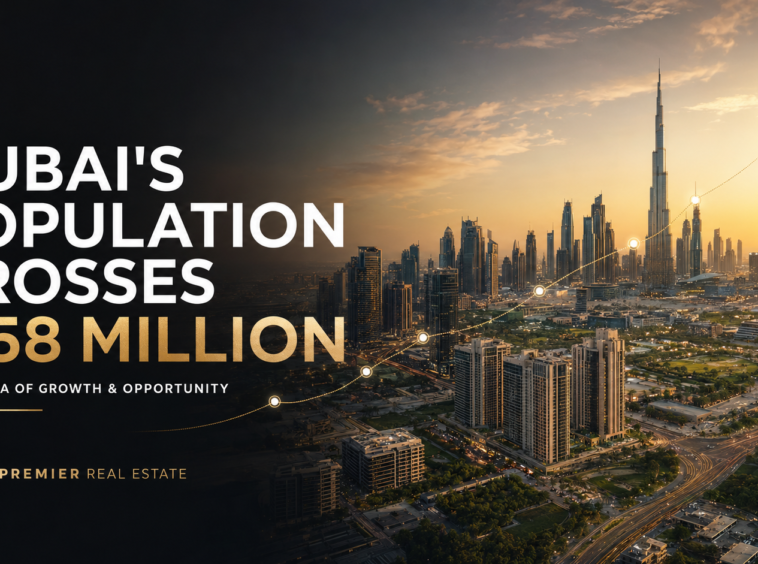
Dubai has just recorded one of the fastest population surges in its history — and for anyone weighing a Dubai real estate investment, the message could not be clearer. The emirate’s resident population has crossed 4.58 million, adding roughly 332,000 people in a single year. At Falcon Premier Real Estate, we read these numbers the way seasoned investors do: every new resident is a future tenant, a future buyer, and a fresh unit of demand pressing against a finite supply of quality homes.
The headline: 4.58 million residents, 6.39 million by day
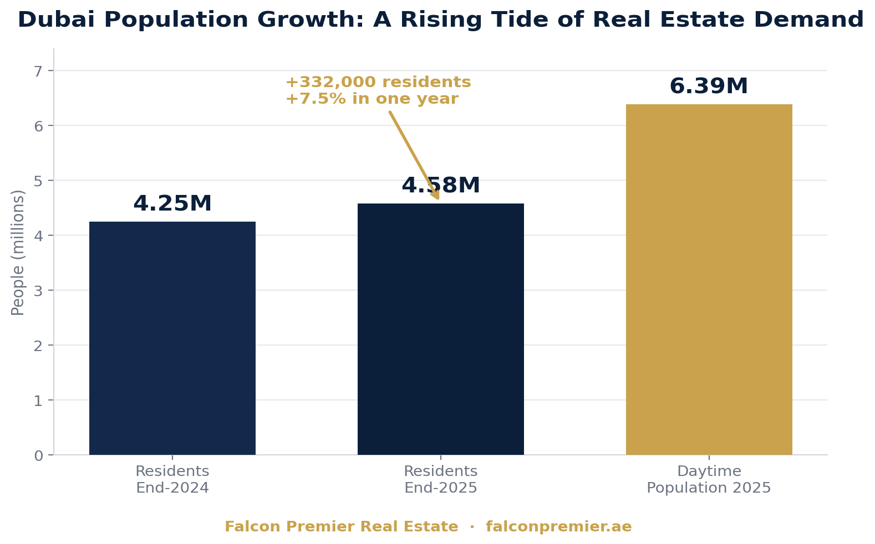
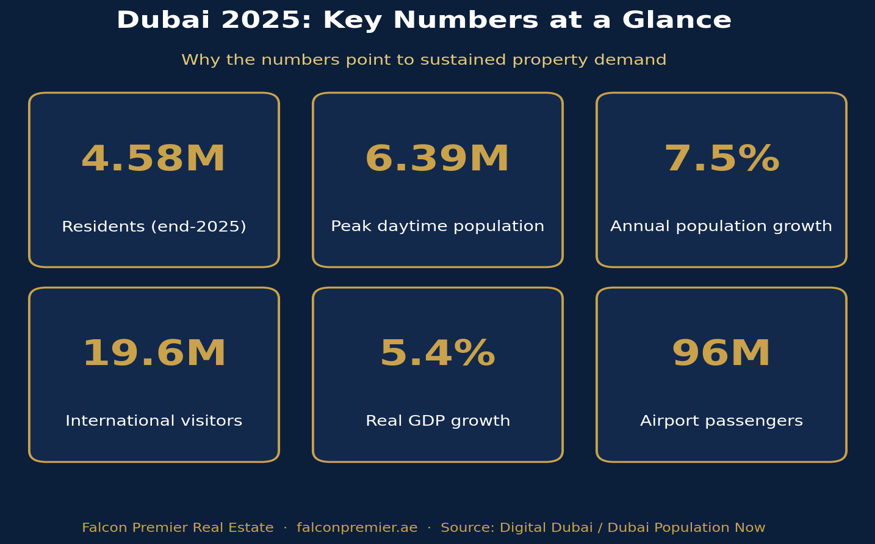
According to Digital Dubai’s new Dubai Population Now initiative, the emirate’s resident population reached 4.580 million by the end of 2025, up from 4.248 million a year earlier — a 7.5% annual growth rate. But the resident figure only tells half the story. During peak daytime hours, the number of people physically present in Dubai climbs to 6.392 million, swelled by workers, tourists, students and shoppers. On an average day, more than 1.8 million people are temporarily present in the city.
For property owners and investors, that daytime figure is gold. It reflects the sheer intensity of economic activity around Dubai’s commercial districts, retail hubs and lifestyle destinations — the same locations where rental yields and capital appreciation tend to outperform.
Why population growth is the engine of a Dubai real estate investment
Real estate is, at its heart, a bet on people. More residents means more demand for homes to rent and buy, more pressure on prime neighbourhoods, and a longer runway for capital growth. Dubai’s 7.5% population increase is not a one-off spike — it sits on top of world-class infrastructure, business-friendly regulation, and a proven ability to attract global talent and capital.
Consider the wider backdrop that accompanied this population milestone in 2025:
- 5.4% real GDP growth — a diversified, resilient economy expanding at pace.
- 19.6 million international visitors — up 5% year on year, feeding short-stay and holiday-home demand.
- 96 million airport passengers — up 4.9%, underlining Dubai’s status as a global connectivity hub.
When population, tourism, and GDP all rise together, they reinforce one another. That virtuous cycle is precisely what makes a Dubai real estate investment so compelling for both end-users and yield-focused investors.
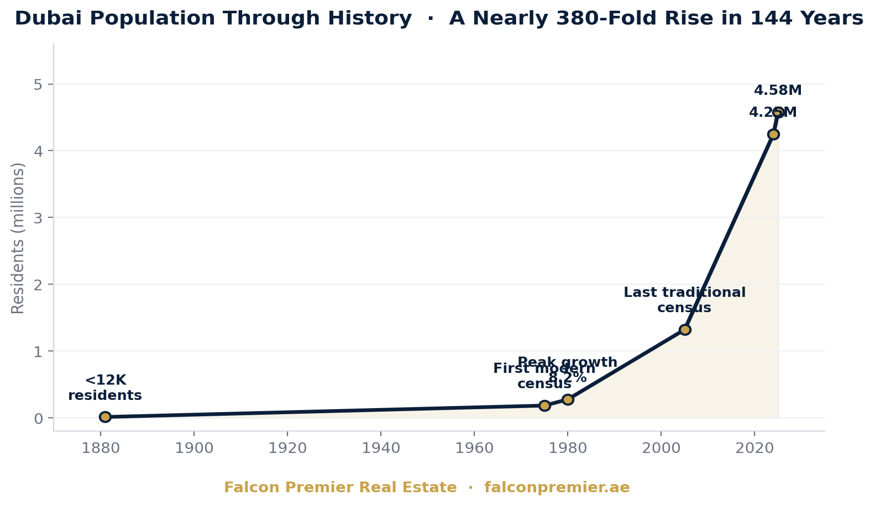
A city that has grown nearly 380-fold in 144 years
Dubai’s rise is one of the great growth stories of the modern era. In 1881, fewer than 12,000 people lived here. The first modern census arrived in 1975; the highest annual growth rate on record, 8.2%, came in 1980. The last traditional census was conducted in 2005. Fast-forward to today and the emirate is home to 4.58 million residents — a nearly 380-fold increase in 144 years.
What matters for investors is not just how far Dubai has come, but the direction of travel. Independent forecasts point to continued momentum, with the economy widely expected to keep expanding in 2026 on the back of tourism, population and consumer spending. Cities that grow this consistently create durable, structural demand for housing — the kind that supports both rental income and long-term appreciation.
The AI-driven census: better data, smarter planning
There is a quieter but equally important story here. The 4.58 million figure comes from a new AI-powered, real-time monitoring system approved by Sheikh Hamdan bin Mohammed bin Rashid Al Maktoum, Crown Prince of Dubai. Instead of a traditional census every few years, Dubai Population Now continuously integrates data from government entities — including the Dubai Land Department, RTA, DEWA, Dubai Municipality and others — using artificial intelligence, machine learning and predictive analytics.
For the property market, this means planning for housing, transport, schools and healthcare is now driven by live, trusted data rather than dated surveys. Infrastructure and services can keep pace with growth in real time — reducing the risk of the bottlenecks that can plague fast-growing cities and protecting the long-term liveability that underpins property values.
What this means for buyers and investors right now
A rising population against a backdrop of strong GDP and record tourism creates a classic demand-led market. Here is how we at Falcon Premier see the opportunity:
- Rental demand is structural, not seasonal. With 332,000 new residents a year and 1.8 million daily visitors, well-located rental stock rarely stays empty for long.
- Off-plan and emerging communities offer entry points. As the city expands outward, early buyers in new growth corridors can capture appreciation as infrastructure catches up.
- Prime and daytime-hub locations command premiums. Areas tied to that 6.39 million daytime population tend to deliver stronger yields.
- Timing favours the prepared. Demand fundamentals like these reward investors who act with good advice rather than waiting for the crowd.
Make Dubai’s growth work for your portfolio
Dubai’s population story is, ultimately, a demand story — and demand is what turns a property purchase into a performing asset. Whether you are buying your first home, adding a rental unit, or building a portfolio, a well-chosen Dubai real estate investment lets you participate directly in one of the world’s most dynamic growth markets.
Ready to explore the right opportunity for you? The team at Falcon Premier Real Estate can help you identify the communities, property types and price points best positioned to benefit from Dubai’s continued expansion. Get in touch with Falcon Premier today for a personalised consultation.
Data sourced from Digital Dubai’s ‘Dubai Population Now’ initiative and the Dubai Data and Statistics Establishment (end-2025 figures), as reported by Gulf News.